
Understanding Water Damage Restoration Services in Lawton, OK
Water damage is the claim most Oklahoma homeowners are likeliest to file after wind and hail, and the one they understand least going in.
Insurance Information Institute data drawn from ISO for 2018 through 2022 shows water damage and freezing hitting about 1 in 60 insured homes every year, with an average claim of $13,954. In 2022 it made up 27.6% of all homeowners claims nationally, second only to wind and hail. The same data set puts Oklahoma's average homeowners premium at $2,155 in 2021, third highest in the country.
So it is common, it is expensive, and it happens here more than most places. Here is what the work actually consists of.
Mitigation and restoration are different phases
These words get used interchangeably in marketing and they should not be.
Mitigation is stopping the loss and preventing further damage. Extraction, drying, removal of unsalvageable material, containment. It is measured in days and it is time critical.
Restoration is putting the property back. Drywall, flooring, trim, paint, cabinetry. It is measured in weeks and it is not time critical in the same way, because the damage has already stopped.
Most of what determines the final cost of a water loss happens during mitigation, in the first 72 hours, before most homeowners have even spoken to an adjuster.
Not all water is the same
The industry works from the ANSI/IICRC S500 Standard for Professional Water Damage Restoration, currently in its Fifth Edition from 2021. It is a consensus standard developed through the American National Standards Institute process, and it is the document adjusters and contractors both reference when there is a disagreement about scope.
The standard sorts water intrusions by category, based on how contaminated the source is. In plain terms:
Category 1 is water from a clean, sanitary source. A supply line, a water heater, a burst pipe carrying potable water. Most material can be dried and saved.
Category 2 carries significant contamination and has the potential to cause illness. Washing machine or dishwasher discharge, toilet overflow with urine but no solids, sump pump failure.
Category 3 is grossly contaminated. Sewage, rising floodwater from outside, anything carrying pathogens. Porous materials it touched come out, and the work requires different protective equipment and disposal handling.
Two things about categories that matter to you as a property owner.
First, category is not fixed. Clean water sitting in a warm house picks up contamination from the materials it soaks and from what is already in the building. A Category 1 loss left alone becomes something worse.
Second, category drives scope. When a contractor tells you the carpet pad has to go but the carpet can stay, or that the bottom two feet of drywall are coming out, the category is usually why.
The standard also classifies losses by how much water is present and how much of the material can absorb it, which determines how much drying equipment the job needs. That is the calculation behind the number of air movers and dehumidifiers that show up at your house. It is not a guess.
Drying is measured, not eyeballed
This is the part homeowners find least intuitive and it matters most.
A surface can feel dry to the hand and read wet on a meter. Framing lumber, subfloor, and the back side of drywall hold moisture long after the visible surface stops feeling damp. The S500 defines drying completion by measured moisture content in the structure, not by appearance.
In practice that means a crew should be:
- Taking moisture readings at set points, in affected material and in unaffected material of the same type as a reference
- Logging those readings daily, not just at the start and the end
- Adjusting equipment placement based on what the readings show
- Ending the drying phase when the numbers say so
If a contractor sets fans and comes back in three days to pick them up without a single documented reading, you have no evidence the structure was dry when they closed it. Neither does your insurance company.
Ask for the moisture logs. A legitimate outfit will hand them over without hesitation.
The window you are working against
EPA's guidance on mold, moisture and your home states that if wet or damp materials and areas are dried within 24 to 48 hours, in most cases mold will not grow. EPA also recommends holding indoor relative humidity below 60%, ideally between 30 and 50%.
Two days is not much time, particularly if the water started overnight or while you were away. It is why restoration companies operate 24 hours and why the first call matters more than which company you eventually pick.
Miss it and the job changes shape. Water damage becomes water damage plus mold remediation, which means containment, additional demolition, and a second scope on the same claim.
What a water damage job looks like start to finish
Emergency response and source control. Stop the water. Sometimes that is a shutoff valve, sometimes it needs a plumber. Worth noting: the S500 assumes that finding and correcting the underlying cause of the intrusion is the property owner's responsibility, not the restorer's, unless you contract for it separately. If a contractor says "we dry, you call a plumber," they are following the standard, not dodging you.
Assessment. Category determination, moisture mapping with meters and often thermal imaging to trace where water migrated, and a written scope. Photographs throughout.
Extraction. Standing water and water held in carpet and pad removed with truck-mounted or portable extraction. Getting water out mechanically is dramatically faster and cheaper than evaporating it.
Controlled demolition. Removal of materials that cannot be dried in place. Carpet pad, saturated insulation, affected drywall, sometimes flooring. Also drilling or removing baseboard to open wall cavities so trapped water can escape.
Structural drying. Air movers to move moisture out of materials into the air, dehumidifiers to pull it out of the air, sometimes heat and specialty drying systems for hardwood or wall cavities. Daily monitoring.
Verification. Confirming materials reached the drying goal against reference readings before anything is closed up.
Reconstruction. Rebuilding what was removed.
Questions to ask before you sign
- What category is this water and how did you determine it?
- Will you provide daily moisture logs, and can I see them?
- What is the drying goal for my materials and how will you confirm it was reached?
- What is coming out and what is staying, and why?
- Do you also handle the reconstruction, or does that go to someone else?
- Will you work directly with my insurance adjuster?
The fifth question is the one people skip and regret. When mitigation and rebuild are two different companies, the moisture documentation often does not travel between them, and walls get closed over framing nobody confirmed was dry.
Where we come in
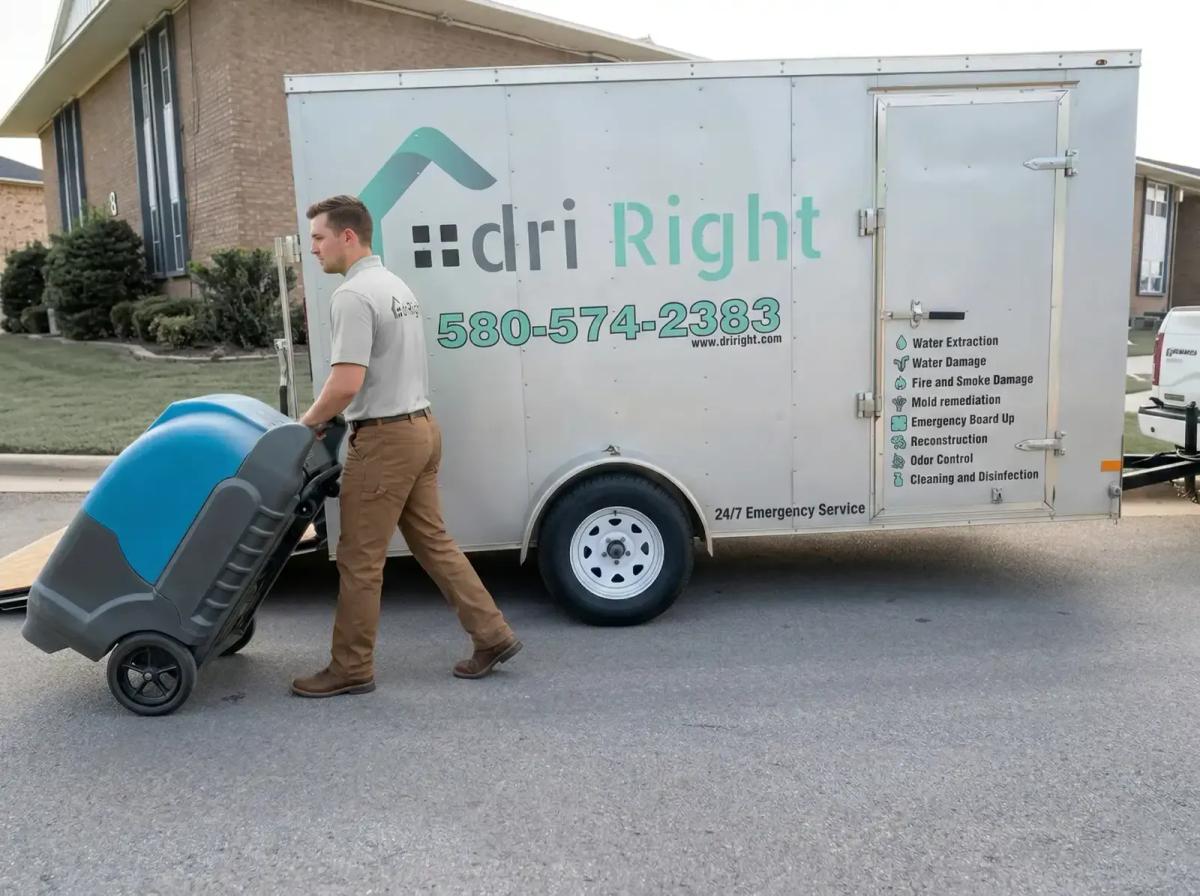
Dri Right is based in Lawton and has served Comanche County since 2018. We handle emergency water extraction, structural drying, mold remediation when it is needed, contents pack-out, and the reconstruction that follows, which keeps the whole job and the whole moisture record under one contract.
Our technicians and our business carry IICRC certification, we carry liability, pollution, auto, and workers compensation coverage, and we work directly with your insurance company through the claim. We keep technicians on call 24 hours a day, with a usual response of under an hour from your call to a crew loaded and moving.
If you are standing in water right now, shut off the source if you safely can, and call us at (580) 574-2383. The clock started when the water did.


