
Avoid Mold Issues With Crawlspace Encapsulation in Norman, OK
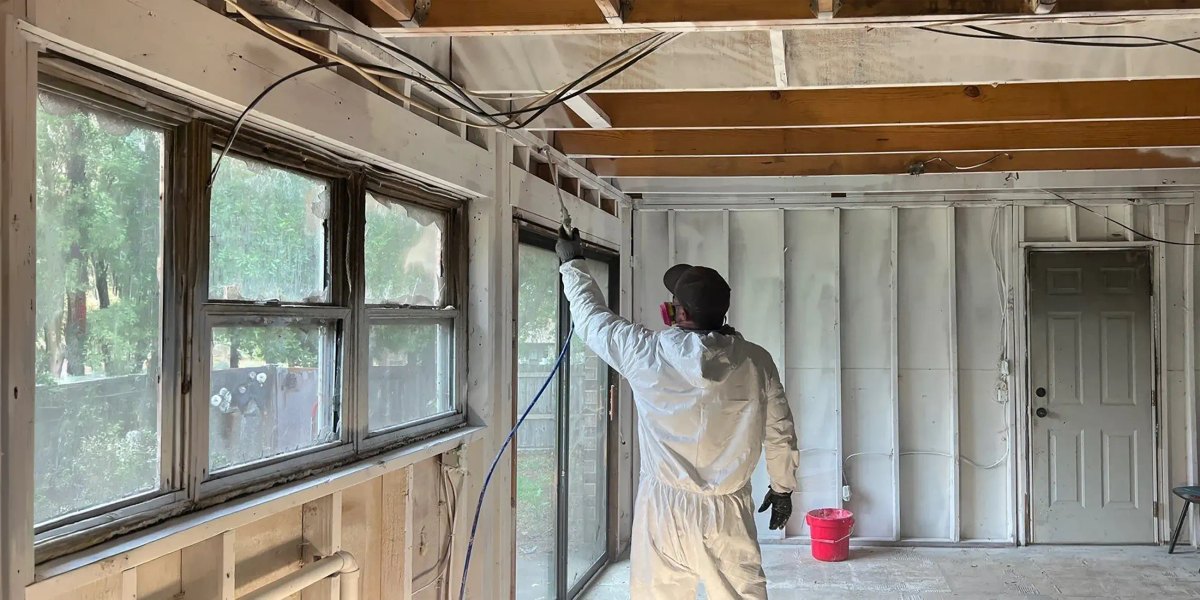
Most Norman homeowners find out about their crawlspace the same way. A musty smell in the hallway that will not go away. Hardwood that cups along one wall. A floor that feels spongy near the back bedroom. Somebody finally pulls the access panel off, shines a light under the house, and finds beads of water on the ductwork and gray fuzz creeping along the joists.
The instinct at that point is to add ventilation. Open the vents wider, put in a fan, get some air moving under there. That instinct is wrong, and it has been demonstrably wrong for about fifty years.
Venting a crawlspace with outside air makes it wetter
This is the part that surprises people, so it is worth walking through the physics.
Advanced Energy ran a multi-year controlled field study in Princeville, North Carolina under a US Department of Energy contract, comparing wall-vented crawlspaces against closed ones on the same street. Their report on closed crawl spaces found that the wall-vented crawlspaces sat above 80% relative humidity for most of the spring and summer, while the closed designs held below 65% over the same months. The study is from 2005, and it remains the controlled comparison the North Carolina crawlspace code was built on.
Here is why the vents make it worse. Say it is 85 degrees outside with 60% humidity, which sounds warm and dry. The dew point of that air is about 70 degrees. Now push it into a crawlspace where the ground keeps the temperature around 73 degrees. No moisture was removed, so the dew point is still 70. But the air is colder now, and colder air holds less vapor, so the relative humidity jumps to roughly 90%. Meanwhile the ductwork, the copper lines, and the underside of the insulation are all sitting below 70 degrees, so water condenses directly onto them.
Ventilating a crawlspace in an Oklahoma July does not dry it. It delivers water.
Advanced Energy documented a case where a contractor saw light mold on floor joists and installed a powered ventilation fan to fix it. So much water condensed afterward that rot destroyed the lower portion of the joists.
Where the vent requirement came from
If venting is this counterproductive, why did every building code require it?
Advanced Energy traced the history, drawing on work by building scientist William Rose. The earliest recommendations to vent crawlspaces with outside air appear in National Bureau of Standards guidance in 1923 and Federal Housing Administration guidance in 1935. The FHA turned those recommendations into requirements in the early 1940s. Crawlspaces were already failing in the 1930s and there was no technical justification offered at the time. The requirement spread across American building codes anyway and stayed there for sixty years.
That is worth knowing if a contractor tells you the vents are there for a reason. They are there for a historical reason, not a building science one.
The moisture numbers that actually matter
Two thresholds are worth committing to memory.
The EPA recommends keeping indoor relative humidity below 60%, ideally between 30 and 50%, in its brief guide to mold and moisture. Above 60%, condensation becomes likely, and condensation is what feeds mold.
The second is wood moisture content. Advanced Energy found that when humidity drives wood moisture content to 19% or higher, conditions are right for surface mold, and blooms can appear in as little as 48 hours. Your joists and subfloor are the fuel.
A relative humidity meter costs somewhere between $10 and $50 at a hardware store, according to EPA. If you want one number that tells you whether your crawlspace is a problem, that is the one. Put it under the house in June and check it in July.
What encapsulation includes, and what it does not
Encapsulation is a system, not a sheet of plastic. A vapor barrier laid loose over the dirt is a partial measure that addresses exactly one moisture source. The full assembly Advanced Energy documented has several parts working together:
- Exterior water management first. Gutters and downspouts carrying roof runoff away from the house, and finished grade sloping at least 6 inches over the first 10 feet.
- A minimum 6-mil polyethylene ground vapor retarder covering 100% of the soil, with seams lapped at least 12 inches and sealed, running up the perimeter walls and at least 4 inches up the interior piers.
- A 3-inch termite inspection gap left bare at the top of the masonry wall so pest control can still see the sill plate. Cover that gap and your pest company may refuse to warranty the house.
- Air sealing at every penetration: the sill plate, the band joist, plumbing and electrical runs, and any gaps around HVAC ductwork through the wall.
- Vents closed. Not covered with a screen. Closed and sealed.
- A drying mechanism, either conditioned supply air from the HVAC system or a dedicated dehumidifier of at least 15 pints per day capacity, with the condensate piped outside.
- A drain or sump pump at the low point, so a plumbing failure or heavy rain has somewhere to go.
Skip the drying mechanism and the whole thing can backfire. Moisture still gets into a closed crawlspace by wicking up through masonry and by air leakage you cannot fully eliminate. If nothing is actively removing it, you have built a sealed box around a wet problem.
The health side
Damp crawlspaces do not stay in the crawlspace. Air moves upward through a house, and it carries whatever is under the floor with it.
The Institute of Medicine's 2004 review, summarized by CDC, found sufficient evidence linking indoor mold exposure to upper respiratory symptoms, cough, and wheeze in otherwise healthy people, to asthma symptoms in people who already have asthma, and to hypersensitivity pneumonitis in susceptible individuals. A 2007 meta-analysis of 33 studies by Fisk, Lei-Gomez and Mendell, cited in the WHO guidelines on dampness and mould, found that building dampness is associated with roughly 30 to 50% increases across a range of respiratory outcomes.
CDC also makes a point that saves people money: there are no established standards for an acceptable quantity of mold in a home, and testing cannot tell you whether a particular person will react. If you can see it or smell it, the response is the same either way. Remove it and fix the water.
Is encapsulation worth it in Norman?
Honest answer: it depends on what your crawlspace is doing right now, and a good contractor should tell you if you do not need it.
If your crawlspace is dry, the ground is already covered, humidity reads in the 50s through August, and there is no odor upstairs, spend your money elsewhere. If you are reading 70% and up in the summer, seeing condensation on ducts or pipes, smelling something musty in the house, or looking at cupped floors, the moisture is already doing damage and adding vents will accelerate it.
There is a side benefit worth mentioning. Advanced Energy measured up to 15% savings on annual heating and cooling energy in homes on closed crawlspaces compared with wall-vented ones. That is real, but it is not the reason to do the work. The reason is that joists and subfloor are expensive to replace and cheap to protect.
Crawlspace encapsulation and repair is one of the services we handle at Dri Right, alongside mold testing and removal, and we would rather look at your actual humidity readings than sell you a system you do not need. If you are dealing with a musty smell, visible growth on joists, or soft spots in the floor and you want someone to crawl under there and tell you straight what is going on, call us at (580) 574-2383.


